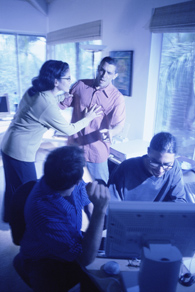
M.O.: Armed bank takeover. Subject entered bank wearing a paint-splattered bandana over his face and displaying a large silver semiautomatic pistol. Placed a green/white "Igloo" type cooler on counter and demanded that the tellers give him the money. Subject put money into the cooler. Used profanity when demanding money from the tellers. Fled down an alley near the bank. No vehicle observed.

Programs designed to minimize the chances of a robbery turning violent are available through the Workplace Trauma Center. These programs are customized for particular businesses. For example, after responding to over 350 bank robberies, Dr. Richard Ottenstein, Director of the Workplace Trauma Center, has designed a robbery training program specific to the banking industry. Bank Robbery Survival teaches branch staff techniques to control themselves, customers and the robbery situation in order to minimize or eliminate violence during the robbery. Studies show that pre-robbery education can help staff avoid dangerous mistakes and assist in apprehending the robber. The following topics are covered during the Bank Robbery Survival Training and can be customized based on your business's particular security policies:
Bank Robbery Survival
The Bank Robber- Bank robbers can be career criminals, or opportunists who need money. They may work alone or with one or more accomplices. The career bank robber has a method of operation (MO) and is interested in getting the most money in the shortest period of time. They may be well armed, and because they have committed other bank robberies, they may do anything to avoid apprehension. Attempting to delay this type of bank robber may cause injury. They may be willing to commit assault if their goals are thwarted. the attitude of this bank robber can range from angry, abusive and hostile to gentlemanly and polite. Often times, attitude is part of the strategy used by the robber to get the job done.
The Opportunist robber may have many motivating factors. They may be down and out, a drug addict, a thrill seeker or under peer pressure from a gang. They often have little idea how to rob a bank and may be influenced by what they've seen on TV and movies. They may be nervous and upset and have no real plan as to what they are doing. They may be under the influence of drugs or alcohol or mentally ill. They are unpredictable. Given the diverse nature of bank robbers, there is no safe way to resist their attempts as the risk of injury is great.
How to act during the Bank Robbery- It is suggested that ongoing training allows the staff to act in a methodical "auto-pilot" mode. In this mode, emotions are suppressed and the staff thinks through each action with safety and control in mind. Achieving an "auto-pilot" mode through frequent training enables the staff to feel confident and know what to do during the robbery. Other aspects of training include Clear and Calm Compliance, Control of Customers, and opening the vault under stress.
Evidence Preservation- Learning how to deal with notes that are passed, identifying physical characteristics, pronunciation of words, dialects etc all assist in the apprehension of the robber after the incident.
Post Robbery Security Control- Lock the door, stay in the branch, Call 911, pull alarm. Do not talk with anyone until interviewed by the police. Attend to injuries to staff and customer. Do not assist the perpetrator if he or she is injured. You may be grabbed as a hostage! Observe getaway if it is safe to do so. Follow your post robbery bank procedures. Prepare for the Post Robbery Crisis intervention meeting by contacting The Workplace Trauma Center at 1 877 661-8070.
Disaster Mental Health Training
We can offer training for mental health professionals to provide disaster mental health services. We provide training for government, public non-profit agencies, health care facilities, professional associations and corporations in the development of disaster mental health resources.
These training topics include:
Managinging the Mental Health Consequences of Disaster
Disaster Mental Health Approaches for Health Care Professionals
Psychological First Aid
Disaster preparedness
Disaster Simulations
Critical Incident Team Training and Development
The Workplace Trauma Center can provide Critical Incident Stress Management training. Our experience in training and developing crisis teams around the world can be brought to your agency or corporation. We offer approved International Critical Incident Stress Foundation (ICISF) courses. All ICISF courses are taught be approved trainers and are registered with the ICISF.
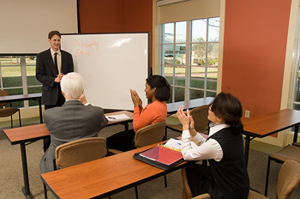
These courses include:
Group Crisis Intervention
Individual Crisis Intervention and Peer Support
Advance Group Crisis Intervention
Corporate Crisis Response
Strategic Response to Crisis
School Crisis Response
Pastoral Crisis Intervention
Suicide Prevention, Intervention and Postvention
Employee Assistance and Corporate Training Services
With the high costs associated with hiring and training qualified employees, personnel retention is commonly a high level management goal. With that in mind, The Workplace Trauma Center offers a range of employee education services. These specialized training programs can be offered on-site as brown bag seminars. Management can choose education topics and a trained clinician will come on-site to conduct a class. Some popular subject matters include smoking cessation, caring for an aged parent, managing a difficult teenager and balancing work and family.
The Workplace Trauma Center can provide services to Employee Assistance Programs (EAP's) to provide seamless delivery of services. We can deliver your training programs, or our own under your corporate logo. Our critical incident responders are able to respond as a part of your EAP crisis team and to utilize your corporate identity. We can even supplement the crisis response capabilities of your EAP by providing additional surge capacity or by providing specific expertise when needed.
5
6
7
8
9
10
All Information on this site Copyright The Workplace Trauma Center 2006.